

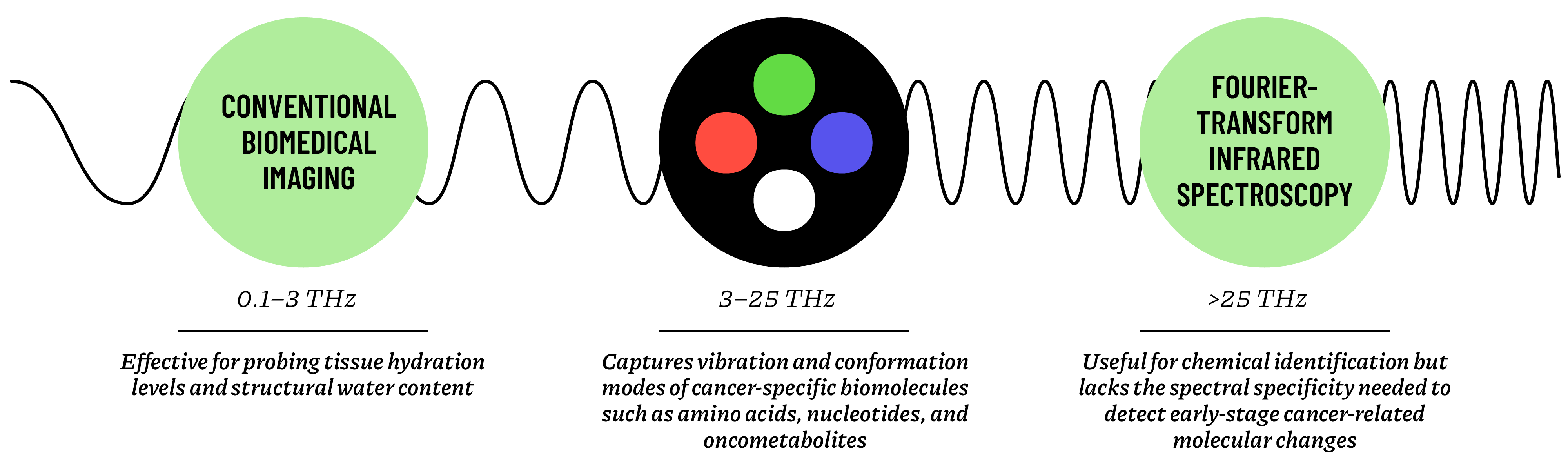
Conventional THz spectrally resolved biomedical imaging has largely concentrated on the 0.1–3 THz range, which is effective for probing tissue hydration levels and structural water content.
Meanwhile, Fourier-transform infrared (FTIR) spectroscopy targets higher-frequency intramolecular vibrations (>25 THz), which – while useful for chemical identification – lack the spectral specificity needed to detect early-stage cancer-related molecular changes.
The THz-Skin project focuses on the 3–25 THz range (100 – 830 cm-1), a scientifically rich but little explored spectral window. This region captures vibration and conformation modes of cancer-specific biomolecules such as amino acids, nucleotides, and oncometabolites.
These biomolecular signatures hold immense potential for high specificity and sensitivity cancer diagnostics, particularly for skin-related malignancies.
Still, the adoption of this spectral band has been severely limited by the lack of efficient, compact, and affordable sources and detectors capable of operating in this THz-FIR (far infrared) region. Current THz and FTIR technologies either lack sufficient spectral resolution, require cryogenic cooling, or are too bulky and costly for practical deployment in clinical or point-of-care settings.
Raman spectroscopy targets the same frequency range but is limited to the skin’s surface and small, micron-size, sampling areas, making it unsuitable for large-scale screening.
THz-Skin overcomes current technological barriers by developing a THz-FIR colour imaging system – a passive imaging platform that utilizes the body’s thermal emissions, eliminating the need for external radiation sources.
Our platform blends high-performance, miniaturized sensors with a large, open-access spectral fingerprint library of skin conditions. Inspired by the RGB model for visible light, our Multifrequency Pixels (MFPs) decompose skin thermal emission into spectral bands in the 3-25 THz range.
Our MFPs consist of compact, low-cost micromechanical bolometers fitted with frequency-selective metasurfaces, achieving high sensitivity and body thermal radiation analysis without cryogenics or bulky spectrometers.
Diagnostic capabilities can be continuously improved by optimising MFP architecture and expanding our spectral library with simulated and experimental data. Detection and control electronics will be based entirely on state-of-the-art field-programmable gate arrays (FPGAs).

